To date no complete business case has been completed. This means that the railway could well be built without anyone having to justify the huge spend of public money.
——————————————
The section between Cambourne Station and Cambridge South is of no benefit to any of the villages between the two stations. There is no public parking at Cambridge South or direct public transport to either station from the outlying villages.
———————————
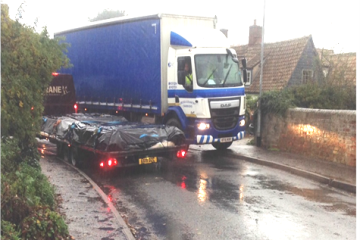
The construction map indicates that10 HGVs or more per day in each direction along Harston Church Street in order to access one of the construction compounds out of the village beside Haslingfield Road. Therefore this proposal is unacceptable for several reasons some shown below :-
1. Church Street was never built to take heavy modern-day lorries. Delivery vehicles to and from Button End have to mount the pavement in places.
2. Church street from the A10 onto the Haslingfield road is very narrow and has a double bend leading onto a river bridge, it is debateable that HGVs could pass without touching mirrors.
A 20-mph speed limit has been agreed for this road, together with speed humps which makes it even more unsuitable for HGVs or even larger vehicles associated with the construction.
3. The bridge over the Rhee is narrow and incredibly old. It is debatable whether it would survive the pounding from heavy lorries passing over it over a long period. It is not wide enough for two passing cars.
4, Harston Surgery is in Church street. It serves many other villages with the majority of patients getting there by car. The Surgery car park is often full and patients then park on the street. This creates havoc with HGVs trying to get past and having to mount the pavements. It is a continuing and increasing concern as the Surgery Patient List grows in line with local development.
5. Church street is overwhelmingly residential and lined with old buildings it is in fact old Harston. it is the original heart of the village. The imposition of noise, damage, pollution and danger of using it as a construction route are completely unacceptable.
6. The safety of the general public and other road users must not and cannot be put at risk during the construction of EWR.
All of the above concerns could be cancelled out by using the on-site construction traffic routes with access from the A10. The onsite routes are shown on the Comberton to Shelford temporary drawing section 7 sheet 04 the only addition required would be a temporary bridge over the River Rhee.
In fact all construction around Harston should adopt using the onsite routes with access from the A10 or London Road this would alleviate the need to use the village minor roads such as Station Road, Church Street or Private Accesses.
All of the Harston village minor roads are in an extremely poor state of repair and would not stand the years of construction traffic pounding over them. If used for access to construction sites EWR must be held responsible for continuous maintenance during the construction period.
Another concern regarding construction traffic is the access from the A505 where it is directed through Whittlesford and Newton to the Harston area again along very narrow roads. Why could these not be directed along the M11 to gain access the Harston area?
———————————-
Reconsideration of the Northern Route . EWR’s own figures published in 2023 show that the Northern route is cheaper and better value for money. The catchment area between Cambourne and Cambridge would be greater, it would stop at Cambridge North Station that serves Cambridge Science Park this is due for massive employment growth, then stopping at Cambridge Central and onto Cambridge South from there on the same line it could serve the Wellcome Genome Campus at Hinxton that is a world leader. Change trains at Cambridge Central to access Cambridge East and beyond. The train care centre could be located near to the Wellcome Campus south of Cambridge.
Freight could be directed via Ely Junction south to the major ports having no need to pass through Cambridge.
————————————-
There is concern regarding the proposed footbridge connecting Newton to Harston and the new link road from Station Road to London Road along the redundant line after the existing road to Newton from Station Road has been severed.
It is believed that the new road and footbridge will not be completed until after the rest of the work has been finished. This will create a considerable inconvenience for Newton village in getting their children to the school or visiting the shops or doctors via a detour route London Road and A10.
A major concern here is that Harston and Newton school could face falling rolls if parents in Newton decide to send their children elsewhere in order to avoid the detour via London Road and the A10 during the years of construction work. The fall in numbers could possibly lead to school closure.
The long ramps up and down the proposed 700-metre-long ramped over-bridge make it a really long and arduous detour. Why cannot the ramps be doubled back and the bridge accessed by steps as well?
————————————-
Failure of Environmental Protection on Southern Route a major difference between the Northern and the Southern route is that the Southern route alone affects the chalk environment of Cambridgeshire. In turn that affects the chalk streams and rivers, particularly the river Rhee at Harston.
The UK is home to 80% of the chalk streams in the world, chalk streams form a unique habitat. The Rhee itself would be particularly vulnerable from the operation of the line, particularly from the freight passing loop located over the river. Given that the freight locomotives would be diesel, there is a clear likelihood of the river being polluted maybe not directly but by seepage.
Of even greater concern is access to water by the construction. Harston is a designated area of water stress. EWR has indicated it will be using large non-potable water tankers for this purpose. There should be an enforceable restriction on any drawing of water from the local aquifers and especially from any of the chalk streams. These are already overstressed.
—————————————
A10 over-bridge plans show the A10 crossing the railway with two massive ramps and a bridge. We understand that the speed limit would be moved out to include the bridge, but it still has the potential to be noisy. Mitigation measures such as noise control features and quiet road surfacing are not mentioned but would be essential to minimise the impact. Screening should also be considered to prevent light pollution towards residential properties from vehicle headlights.
Making the slope as gentle as possible would reduce noise from heavy goods vehicles struggling up-hill.
Street lighting on the bridge must minimise light spill onto the surrounding areas and be habitat friendly.
————————————–
EWR state that it is now their policy to use electric passenger trains with batteries that are topped up by overhead cable located on some sections of the track. Priority must be that diesel freight trains should be replaced by an alternative environmentally friendly power source.
——————————
Requirement for noise control measures It is not good enough to simply build a railway without properly engineered noise mitigation built in from day one.
- Cuttings should be designed to find the optimum way to absorb and deflect noise.
- Noise performance of bridges should be modelled to determine the best profile, using low walls with hard surfaces to deflect noise from the wheels upwards rather than out.
- Elevated sections should be equipped with low walls or noise absorbers to reduce noise from the wheels and track. This is important because an elevated track will radiate noise a long way.
- Track at ground level should be edged with effective noise barriers where it faces housing.
The two passing loops located near Harston where freight trains will park with their engines running will need to be adequately suppressed to prevent noise traveling. No matter what the initial plan is, there is a likelihood that goods traffic will use the line mostly at night, causing intrusive noise in an otherwise quiet area. It is imperative to design in lasting noise mitigation protection from day one.
`——————————
The bridge over the Rhee should be long enough to deal with rare severe flooding ensuring that the track remains above water at all times, this may become much more frequent as the planet warms up.
Wetland should not be used for possible pollution control from polluting runoff. It should be adequate for safeguarding the River Rhee chalk stream that is environmentally sensitive.
Also the very real possibility of pollution and contamination reaching the river from the rail tracks must be properly addressed.
——————————–
The ongoing maintenance of drainage ponds and wetlands and access roads must be the responsibility of EWR and not transfer the ongoing cost to local authorities.
The proposed access roads to rail system compounds and drainage ponds should be gated and secured to prevent unauthorised access after completion of the rail project. EWR must be responsible for public safety in these areas especially the drainage ponds.
Tree planting, tree maintenance, and any replanting must be mandated and programmed which includes looking after them and planting at the right time so they don’t just die off, as seen so often by major new roads.
——————————–
We understand the need to reroute the Harston drift that connects to the Little Shelford road.
We do not understand the need to cut off the entrance to the bridal way named Donkey Lane to Hauxton from London Road. Even if London Road is moving slightly west Donkey Lane could move with it. It is a much-used walking route along London Road into Donkey Lane to Hauxton.
———————————–
Conclusion and Requests
The Southern Route poses unacceptable risks to highway safety, residential amenity, a valued village school, and the internationally rare chalk river environment. We strongly urge East West Rail to:
1. Reconsider the Northern Route as the preferred alignment.
2. If the Southern Route proceeds, adopt the on-site A10 and London Road construction access strategy and implement substantial redesigns and mitigations.
3. Provide full, transparent assessment of environmental, traffic, noise, and community impacts.
4. Incorporate all necessary commitments into the Development Consent Order.
early engagement on alternative solutions and confirmation that these concerns will be fully addressed in the next design and assessment stages. Harston and Newton deserve a scheme that respects their historic character, protects their environment, and safeguards their communities.